An Effective Advocacy Program
Protecting and Advancing the U.S. Flexible Packaging Industry

A Long-Term Integrated Strategy
 FPA has many advocacy priorities, including ensuring the flexible packaging industry is represented in legislative and NGO discussions on solid waste management, material composition transparency, sustainability, the role of packaging in reducing food waste, and food safety issues. Additionally, FPA works to ensure reasonable government regulations around environment, health and safety including the Clean Air Act, water and waste regulations and occupational safety and health rules.
Assisting FPA with advocacy priorities at the federal level is Capitoline Consulting, LLC, a federal government relations firm specializing in a broad base of Executive and Legislative Branch liaison services as well as strategic planning and business development support.
At the state level, FPA is working on its advocacy program with Serlin Haley, a national public law firm that effects change by representing organizations before the executive, legislative, regulatory, and municipal areas of government.
Strategic Engagement & Market Outreach
The FPA Strategic Engagement & Market Outreach Program identifies and protects against threats to the flexible packaging industry in the public policy arena, and promotes the positive profile of flexible packaging to key stakeholders, non-governmental organizations, and policymakers.
FPA is engaged in a long-term public affairs and marketing strategy to prevent negative precedents and potential barriers to the growth of the flexible packaging industry. FPA’s integrated government relations, public affairs, and marketing plan promotes and protects flexible packaging, enabling it to remain a preferred packaging option for consumer product companies and consumers and to continue growing in the packaging marketplace.
FPA’s strategies create an integrated national presence that simultaneously affects the decision-makers at all levels and impacts external customers and consumers, allowing FPA to address emerging threats.
Connect With Our Advocacy Leadership Team
Have questions about pending state packaging legislation, compliance guidelines, or how to get involved in FPA’s grassroots efforts? Reach out directly to our issue experts.
|
|
|
|


Core Issue Monitoring & Key Messages
Active Threat Monitoring List
We actively protect and defend our members against:
- Extended Producer Responsibility (EPR)
- Restrictions on Non-Recyclable Packaging
- Recycled Content Mandates for Flexible Packaging
- Disposal Bans for Flexible Packaging
- Special Fees on Flexible Packaging
- Restrictions on Flexible Packaging Recycling Programs – such as restrictions on collection locations, restricting access to the single-stream recycling system, or restrictions on hauling flexible packaging materials
- Restrictions on chemical use and material bans
Core Industry Pillars & Key Messages
- Flexible packaging requires less material and energy to manufacture and to transport, and generates smaller quantities of greenhouse gases on its way to market.
- Flexible packaging is lightweight and easy to open, carry, store, and reseal.
- Flexible packaging extends the shelf life of many products, including food, and has a positive sustainability profile.
- Flexible packaging ultimately results in less consumer waste being sent to landfills, and the industry is working on resource recovery and other end-of-use solutions.
Member Toolkit & Media Resources
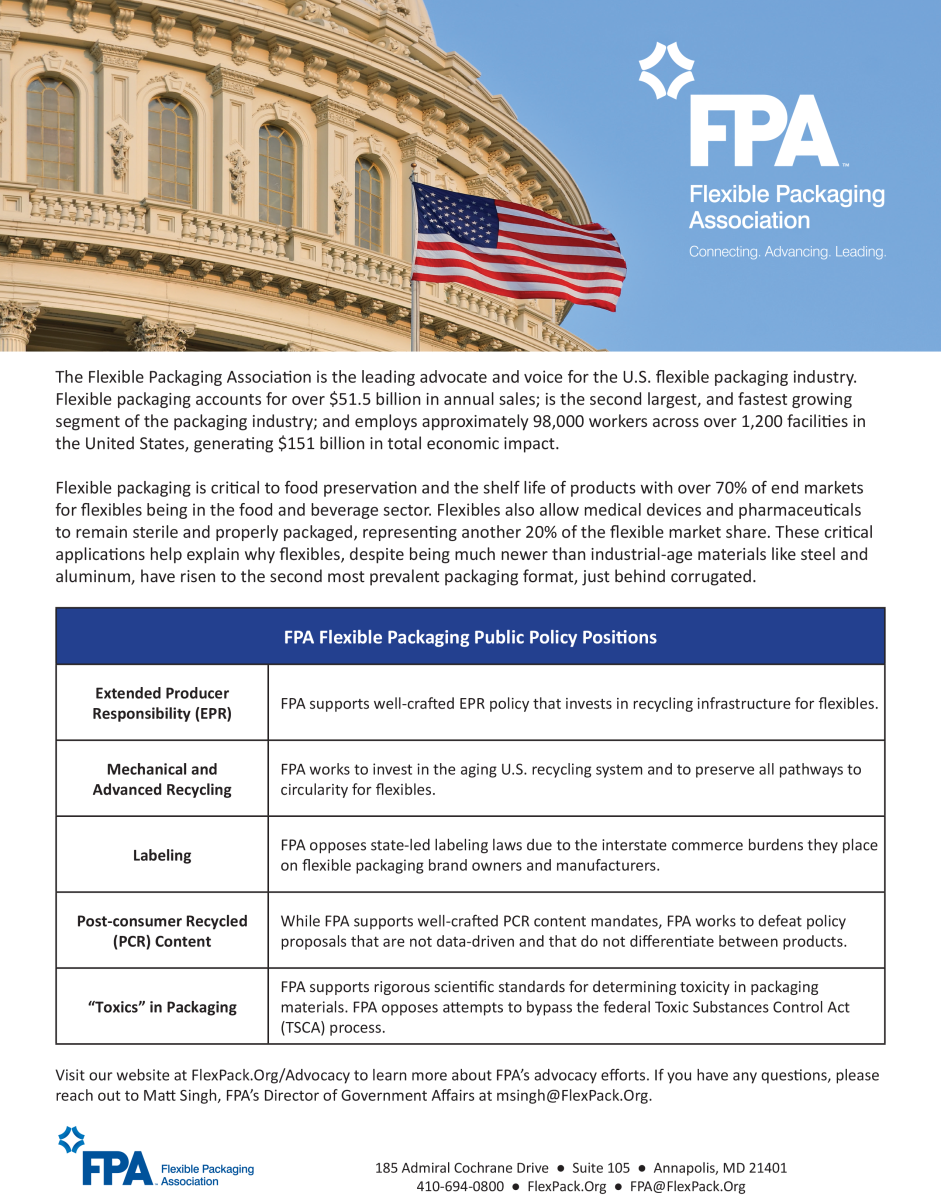 Flexible Packaging Public Policy Positions
The Flexible Packaging Association is the leading advocate and voice for the U.S. flexible packaging industry. Flexible packaging accounts for over $51.5 billion in annual sales; is the second largest, and fastest growing segment of the packaging industry; and employs approximately 98,000 workers across over 1,200 facilities in the United States, generating $151 billion in total economic impact.
Flexible packaging is critical to food preservation and product shelf life, with over 70% of flexible packaging end markets in the food and beverage sector. Flexibles also enable medical devices and pharmaceuticals to remain sterile and properly packaged, accounting for another 20% of the flexible market share. These critical applications help explain why flexibles, despite being much newer than industrial-age materials like steel and aluminum, have risen to the second most prevalent packaging format, just behind corrugated. This documents FPA's position policies on EPR, mechanical and advanced recycling, labeling, post-consumer recycled (PCR) content, and “toxics” in packaging.
Download Document
FPA Position on PFAS Statements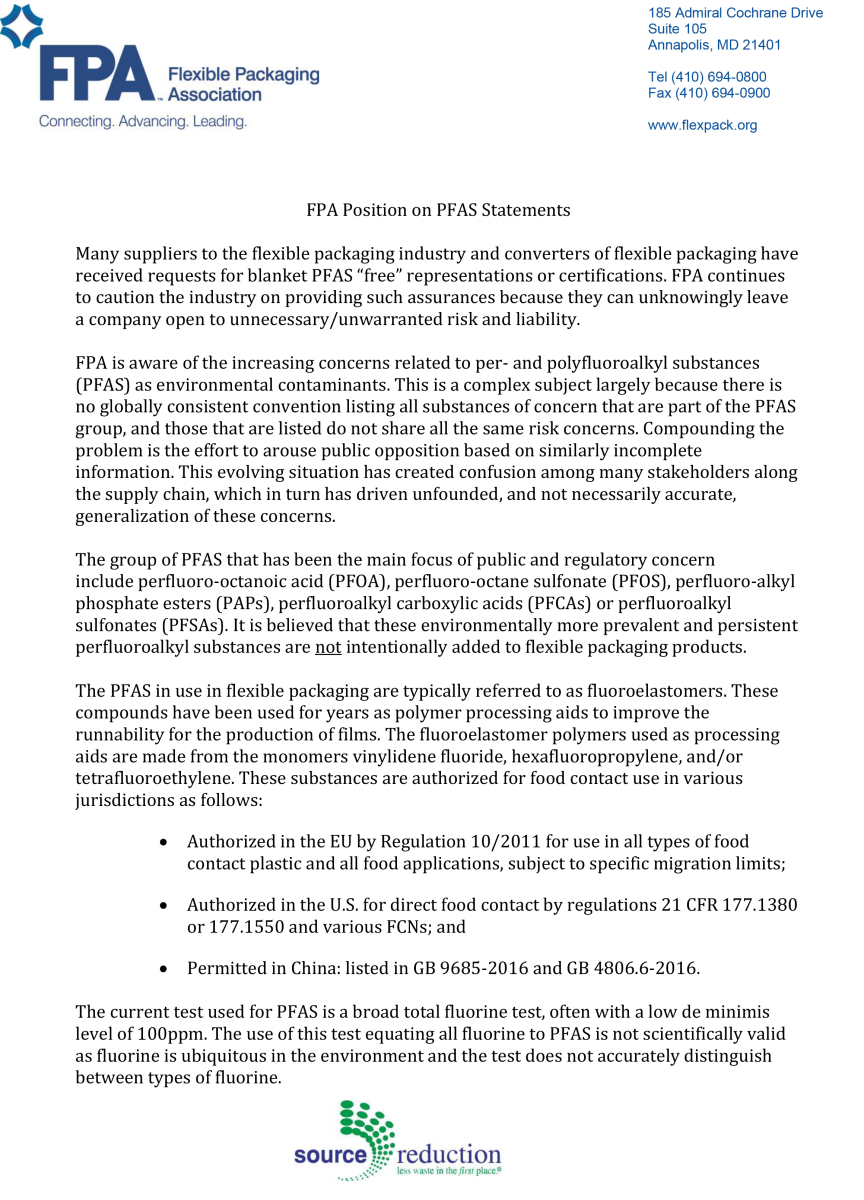
Many suppliers to the flexible packaging industry and converters of flexible packaging have received requests for blanket PFAS “free” representations or certifications. FPA continues to caution the industry on providing such assurances because they can unknowingly leave a company open to unnecessary/unwarranted risk and liability.
FPA is aware of the increasing concerns related to per- and polyfluoroalkyl substances (PFAS) as environmental contaminants. This is a complex subject largely because there is no globally consistent convention listing all substances of concern that are part of the PFAS group, and those that are listed do not share all the same risk concerns. Compounding the problem is the effort to arouse public opposition based on similarly incomplete information. This evolving situation has created confusion among many stakeholders along the supply chain, which in turn has driven unfounded, and not necessarily accurate, generalization of these concerns.
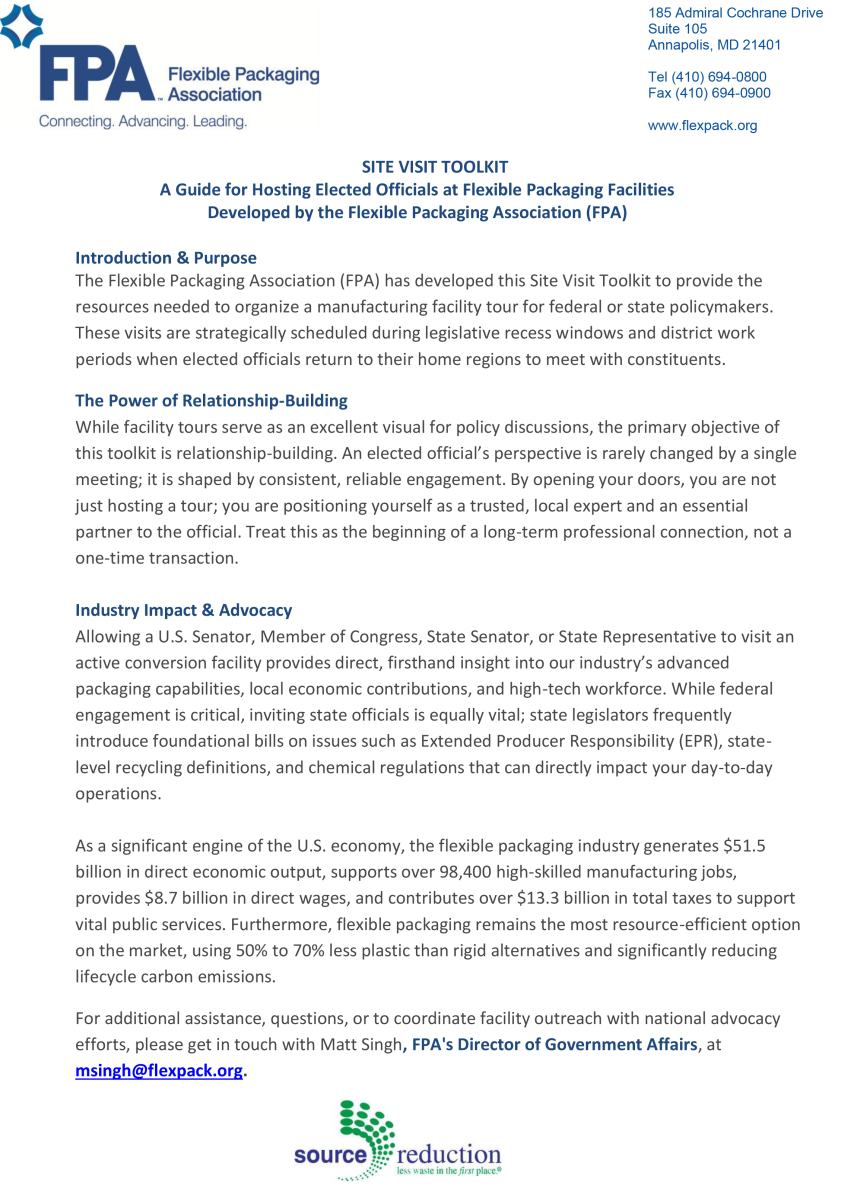 FPA Member Site Visit Toolkit
FPA developed this Site Visit Toolkit to provide the resources needed to organize a manufacturing facility tour for federal or state policymakers. These visits are strategically scheduled during legislative recess windows and district work periods when elected officials return to their home regions to meet with constituents.
While facility tours serve as an excellent visual for policy discussions, the primary objective of this toolkit is relationship-building. An elected official’s perspective is rarely changed by a single meeting; it is shaped by consistent, reliable engagement. By opening your doors, you are not just hosting a tour; you are positioning yourself as a trusted, local expert and an essential partner to the official. Treat this as the beginning of a long-term professional connection, not a one-time transaction.
This resource is only available to FPA members.
Download the Site Visit Toolkit
A Path Toward Circularity for Flexible Packaging
Flexible packaging has evolved over the years to meet the ever-changing needs of consumers. In fact, the advantages of flexible packaging have brought it to par with corrugated packaging. Today's packaging films are highly engineered materials with many technical advancements, designed to perform a variety of tasks while offering one of the most sustainable ways to protect and preserve products during distribution. FPA and its Emerging Leadership Council (ELC) developed a video that explains the benefits of flexible packaging, the need for investment in recycling infrastructure, and the basics of extended producer responsibility (EPR).
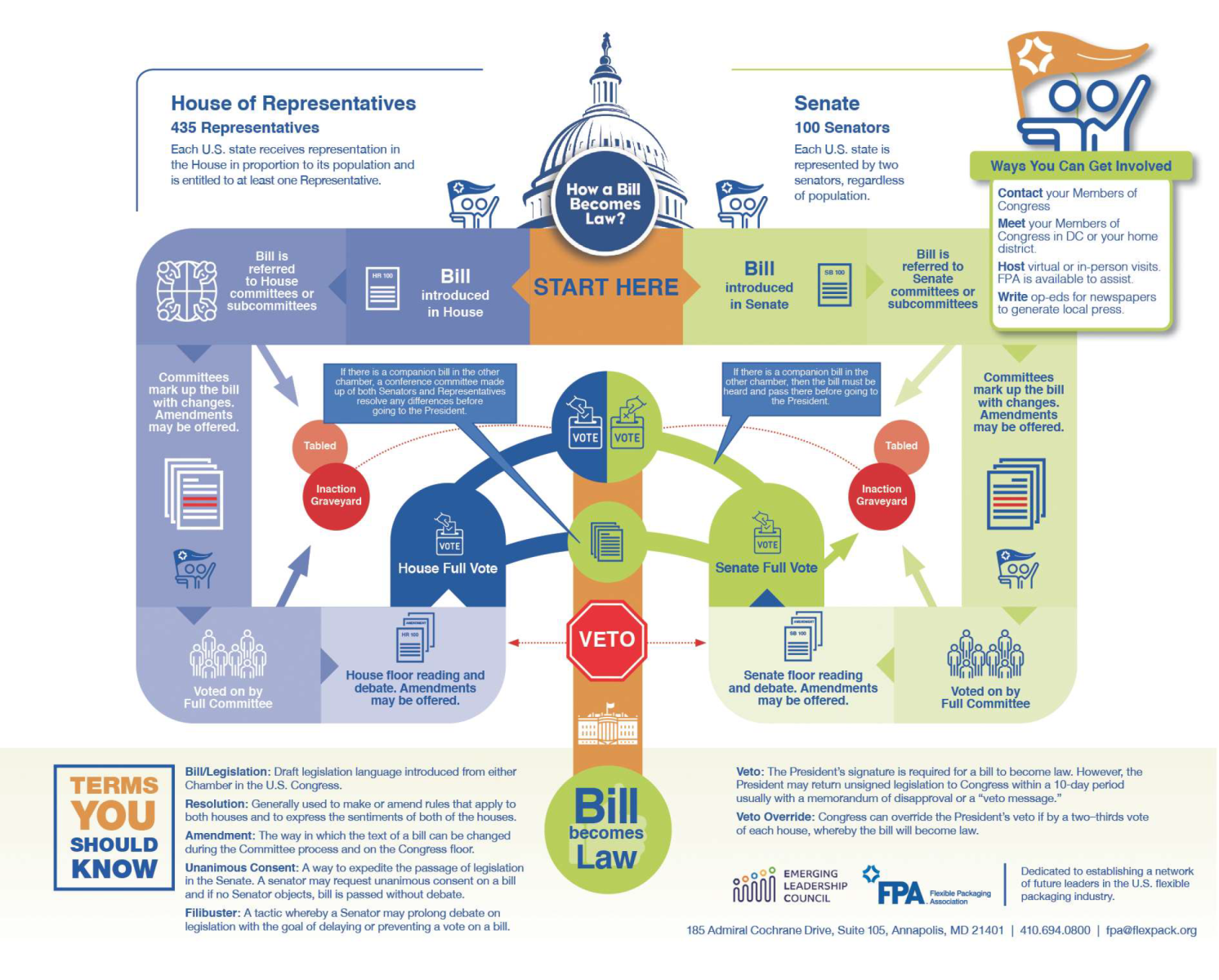
Federal Legislative Process Infographic
This infographic was created by FPA's Emerging Leadership Council’s (ELC) Advocacy Committee. This easy-to-reference graphic outlines the federal legislative process to help gain a better understanding of the path that bills need to take to become law.