Sustainability
Why Sustainability Matters for Flexible Packaging — and How FPA Leads the Way

Our Approach | The Full Picture | Resource Efficiency | Circularity & End-of-Life | Life Cycle & Environmental Data
Food Waste Prevention | Flexible Packaging & Climate Emissions | Flexible Packaging & Accessibility
Flexible packaging is a highly resource-efficient packaging format—yet its full sustainability story is rarely told completely or fairly. From the food waste it prevents and the greenhouse gas emissions it helps avoid across the supply chain, to the accessibility it provides for consumers across every income level and walk of life, flexible packaging delivers environmental and human value that extends far beyond the end-of-life debate that too often dominates the conversation.
At the same time, the industry faces real and pressing challenges—on recyclability, recycled content, circularity, and transparency of claims—that require honest assessment, sustained investment, and genuine collaboration to address. FPA is at the center of that work. Through research, market studies, industry collaborations, and targeted investment across the value chain, FPA and our partners are building the evidence base and the infrastructure needed to ensure that flexible packaging can demonstrate—and continuously improve—its sustainability credentials from design through disposal.
Our Approach
FPA believes that the most sustainable packaging solution is the one that fulfills its protective purpose as efficiently as possible, with the lowest practicable environmental impact across its full life cycle. This means FPA does not advocate for any single material or format as a universal answer. Every application must be evaluated on its own merits—asking hard questions, challenging assumptions, and finding solutions that are both genuinely functional and genuinely responsible.
Sustainability in flexible packaging is not a destination—it is an ongoing, evidence-based process of improvement.
The Full Picture
Understanding the true sustainability of flexible packaging means looking beyond any single metric or moment in a product's life. FPA's work spans the full scope of what that means in practice.
|
🌿 Resource Efficiency: Learn how flexible films use less material, energy, and resources than alternative formats to deliver the same or greater ♻️ Circularity & End of Life: Learn how the industry is working to improve collection, sorting, reprocessing, and recycled content infrastructure to close 🌍 Greenhouse Gas Emissions: Learn how the lightness, compactness, and barrier performance of flexible packaging reduce carbon impact across the
|
Resource Efficiency
Flexible film packaging is redefining what it means to package products sustainably. By using fewer raw materials while delivering exceptional performance, flexible packaging offers compelling resource efficiency benefits that rigid packaging simply cannot match.
The Core Principle: Less Is More
Flexible films are engineered to be incredibly thin yet remarkably functional. Through advanced material science and converting technologies, manufacturers can achieve outstanding barrier, strength, and sealing performance using layers of film that are often measured in microns.
This means:
- Fewer raw materials extracted from natural resources
- Less energy required to produce and process packaging material
- Lower overall weight throughout the entire packaging lifecycle
- Reduced waste generated at every stage of production and use
Material Efficiency by the Numbers
The comparison between flexible packaging and rigid alternatives reveals just how material-efficient flexible films truly are:
|
Packaging Type |
Material Used per Unit |
Relative Weight |
Package-to-Product Ratio |
|
Flexible Pouch |
Very Low |
Lightest |
Lowest |
|
Rigid Plastic Container |
Moderate |
Moderate |
Moderate |
|
Glass Jar |
High |
Heaviest |
Highest |
|
Metal Can |
High |
Heavy |
High |
Key Insight: A flexible stand-up pouch delivering 32 oz. of product can weigh as little as 1.4 oz. compared to a glass jar of the same volume weighing over 20 oz. That is a packaging-to-product ratio advantage of more than 14x.
How Flexible Films Maximize Material Efficiency
🔬 Advanced Multilayer Structures
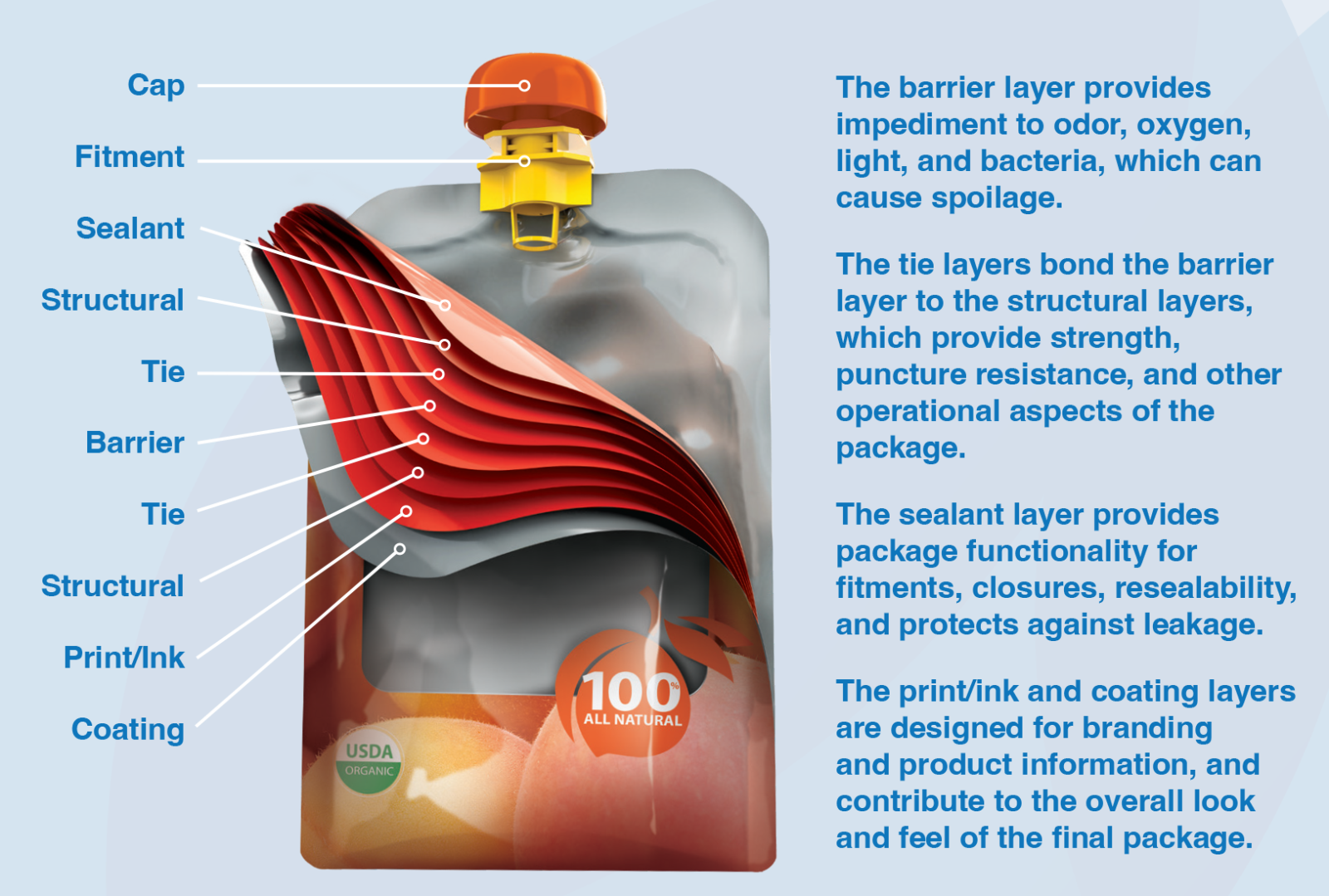
Modern flexible films are generally engineered as multilayer structures, in which each layer serves a precise, optimized function. Sometimes this is multiple different types of materials, or it can be completed as one resin but with multiple layers:
- Outer layers provide printability, scuff resistance, and aesthetics
- Middle layers deliver barrier properties against oxygen, moisture, and light
- Inner layers ensure safe, effective heat sealing and direct food contact
By assigning specific roles to each layer, manufacturers can:
- Use only what is functionally necessary
- Eliminate redundant or excess material
- Achieve performance levels that a single, thicker material could never match
- Continuously optimize and reduce gauge as technology advances
Material efficiency is not simply about using less—it is about using materials smarter. Flexible film packaging exemplifies this philosophy by:
- Engineering every micron of material to serve a purpose
- Continuously innovating to reduce material inputs while improving performance
- Supporting brands in meeting their sustainability commitments without sacrificing product protection or consumer experience
Circularity & End-of-Life
Closing the Loop on Flexible Packaging
The ambition for flexible packaging is clear: materials that protect products effectively, circulate efficiently, and never become waste. Reaching that ambition requires commitment, investment, and recognition about how far there is still to go.
What Does Circularity Actually Mean for Flexible Packaging?
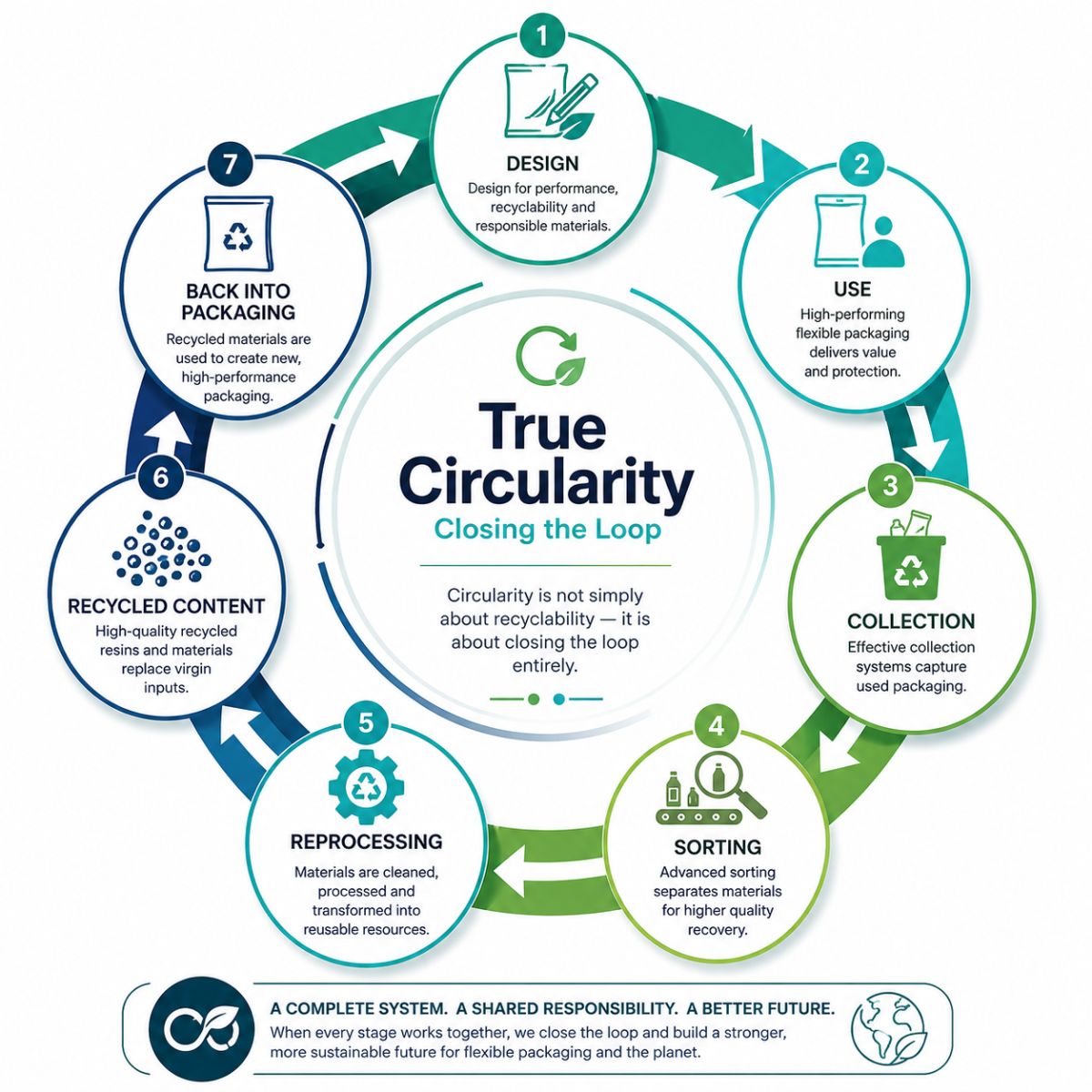
Circularity is not simply about recyclability, it is about closing the loop entirely. A truly circular flexible packaging system requires every stage of the following cycle to function effectively. A breakdown at any single point in this chain means the loop is not closed. Understanding where those gaps exist, and being transparent about them, is the foundation of any credible circularity strategy for flexible packaging.
The Circularity Challenges Specific to Flexible Films
Flexible packaging faces a distinct set of barriers to circularity that set it apart from other packaging formats. Click through each area to understand the current landscape, the progress being made, and the work still required.
🎨 Design for Circularity | 🏷️ Claims & Labeling
🏗️ Collection Infrastructure
Flexible films are largely excluded from curbside collection in many markets. Their low density, tendency to tangle in sorting machinery, and contamination with food residue have historically made them difficult and uneconomical to collect through standard municipal waste streams. Progress is being mad with flexible plastic collection trials expanding across multiple markets, but coverage remains inconsistent and far from universal.
The most successful collection systems to date have been depot and drop-off systems, where consumers return clean and dry flexible polyolefins (resin #2 & #4) to designated collection points. By source-separating films at the point of return, contamination is reduced, and material bypasses complex sortation equipment that is not designed to handle flexible films improving the quality and value of the recovered material entering the reprocessing stream.
Visit Plastic Film Recycling for more information
🔄 Sorting Complexity
Even where flexible films are successfully collected, separating them accurately by polymer type remains technically challenging. Multi-material laminates are particularly difficult to identify, sort, and separate—existing near-infrared (NIR) sorting technology struggles to distinguish complex structures reliably, and contamination between polymer streams reduces the quality and commercial value of the recovered material. Advances in sorting technology and improved material identification systems will be critical to improving the efficiency and accuracy of flexible film sortation at scale.
Download the U.S. Flexible Packaging Market Profile & Segmentation Report
📦 Reprocessing Capability
Flexible film recyclate must be reprocessed into a form that can re-enter the supply chain as a usable material. Mechanical recycling of flexible films is technically feasible but produces recyclate of varying quality, often directed toward lower-value applications, such as refuse sacks or construction materials, rather than back into food-contact flexible packaging. Chemical recycling, which breaks polymers down to a molecular level, enabling higher-quality outputs, offers significant potential for flexible films but remains at an early stage of commercial scale in most markets. Both pathways require continued investment and development to meet the volume and quality demands of a genuinely circular flexible packaging system.
🔁 Recycled Content in Flexible Packaging
Closing the loop requires recycled material to flow back into new flexible packaging. Recycled content reduces reliance on virgin fossil-based resources, creates the demand signal that sustains collection and reprocessing infrastructure, and demonstrates a tangible, measurable commitment to closing the material loop. But the path is far from straightforward.
Post-consumer recycled flexible film material is variable in quality and consistency, supply at commercial scale remains constrained, food-contact compliance requirements are stringent and technically demanding, and the aesthetic and mechanical performance of recycled content can differ meaningfully from virgin resin in ways that require careful management. At the same time, the opportunities are significant, from regulatory alignment as recycled content mandates increase, to the potential of emerging recycling technologies to unlock food-grade recycled resin from flexible film feedstocks that mechanical recycling cannot yet reach.
Understanding both the genuine constraints and the genuine possibilities is essential to making credible, verifiable progress on recycled content rather than simply responding to regulatory pressure with claims that cannot be fully substantiated.
🎨 Design for Circularity
Sustainable packaging design is one of the most pressing challenges facing the industry today, but sustainability alone cannot be the only lens through which flexible packaging decisions are made. Packaging exists first and foremost to protect, preserve, and deliver a product safely to the end user. When that fundamental purpose is compromised in pursuit of a sustainability goal, the consequences can be counterproductive, wasted product, failed shelf life, or unsafe goods, which often carry a greater environmental cost than the packaging itself.
The real challenge is not choosing between performance and sustainability; it is finding where the two can coexist. Every meaningful evaluation begins with a clear understanding of what the packaging must actually do:
- What does the product require? — Oxygen barrier, moisture control, light protection, puncture resistance, hermetic sealing?
- What is the shelf life expectation? — Days, weeks, months, or years?
- What are the supply chain conditions? — Ambient, chilled, frozen, high humidity, long-distance transit?
- What are the filling and sealing requirements? — High-speed lines, specific seal temperatures, machinability demands?
- What are the regulatory requirements? — Food contact compliance, pharmaceutical standards, child-resistant features?
Only once these questions are answered can a genuine sustainability assessment begin because sustainability must be evaluated in the context of what the packaging needs to achieve, not in isolation from it.
View the Packaging Design Timeline Infographic
🏷️ Claims & Labeling
Clear and consistent on-pack communication around recycling and composting is not simply good practice; it is a prerequisite for circularity. Ensuring consumers understand what to do with packaging at the end of life increases supply, improves material quality, and supports demand for recycled content. Misleading or ambiguous recycling claims, even where unintentional, risk eroding consumer trust, undermining genuine sustainability progress, and exposing brand owners to significant regulatory and legal liability.
| Visit How2Recycle | California SB 343 Fact Sheet |
Environmental Claims: Summary of the FTC Green Guides |
FPA's Role in Advancing Circularity
Circularity requires systems thinking. Where an opportunity exists in one area, a trade-off may be required in another. No single brand owner, converter, resin producer, waste manager, or policymaker can close the loop alone. FPA's sustainability program seeks to advance circularity by working across all of these areas simultaneously, helping to drive environmental performance for flexible films at scale through research, collaboration, advocacy, and the development of shared tools and resources.
Meaningful progress is being made, and there is significantly more work to do. FPA is committed to both.
Life Cycle & Environmental Data
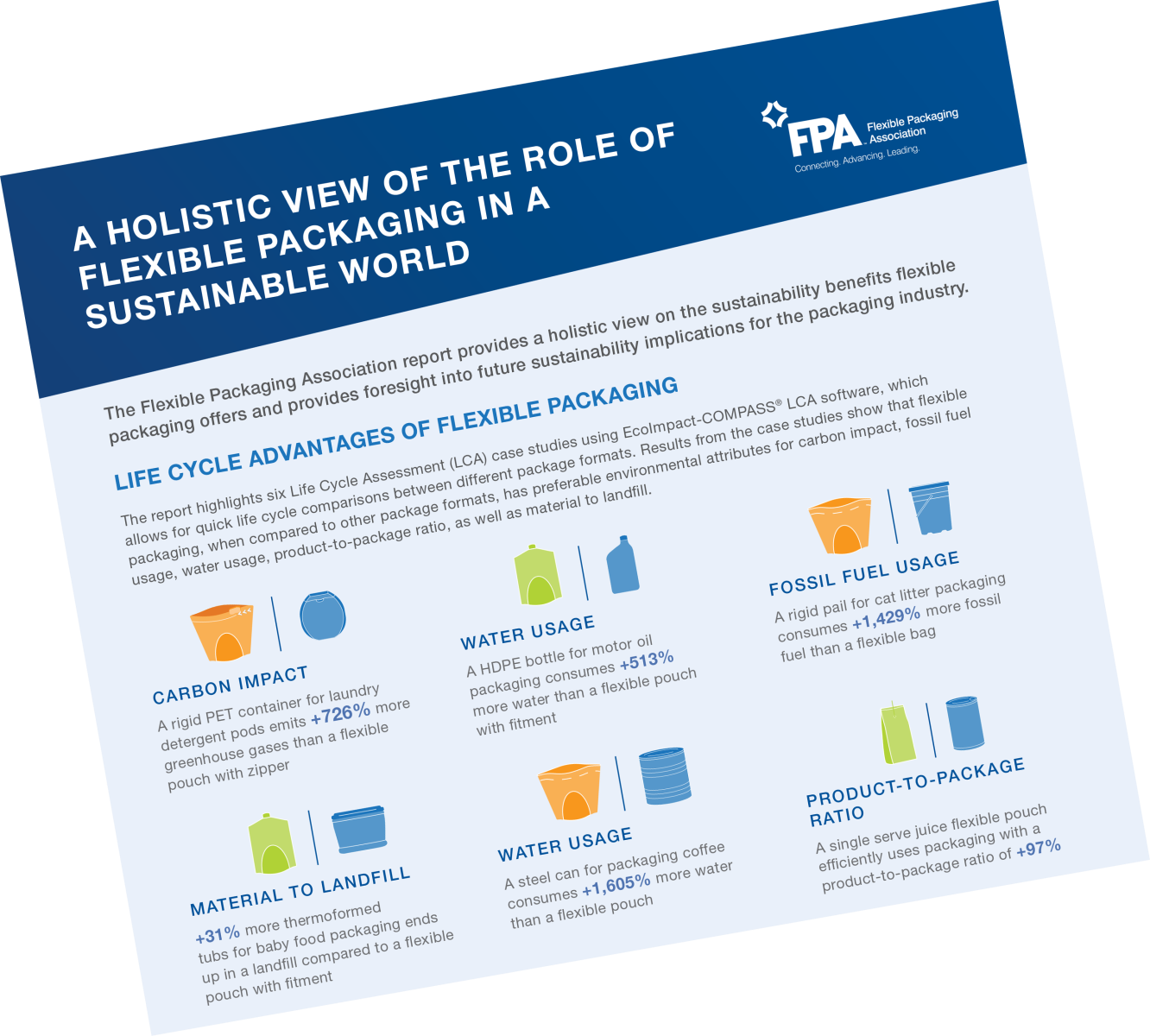
Understanding the full picture, Life Cycle Analysis (LCA) is the gold standard for measuring the true environmental impact from raw material extraction to end of life.
What Is Life Cycle Analysis?
LCA is a systematic, evidence-based methodology that quantifies the environmental impacts of a packaging solution across its entire life cycle capturing metrics such as:
- 🌍 Global warming potential
- ⚡ Energy consumption
- 💧 Water use
- 🪨 Resource depletion
No single-factor assessment can replicate the whole-system insight LCA provides.
Why LCA Is Essential for Flexible Packaging
For flexible packaging, LCA data is particularly powerful because it forces a whole-system view. It can reveal, for example:
- That a multi-material laminate with superior barrier performance and longer shelf life may have a lower net carbon footprint than a simpler mono-material alternative that results in greater food spoilage
- Where lightweighting initiatives deliver genuine carbon savings
- Where a switch to bio-based materials reduces fossil resource dependency without unintended consequences elsewhere in the system
Without LCA, sustainability decisions risk being driven by perception rather than evidence, optimizing for the visible at the expense of the meaningful.
Building Claims That Stand Up to Scrutiny
LCA provides the evidential foundation needed to substantiate sustainability claims with credibility, and defend them under increasing regulatory pressure, including the EU Green Claims Directive, which requires that environmental assertions be backed by robust, independently verified scientific data.
With LCA, brand owners, converters, and specifiers can:
- Make genuinely informed packaging decisions
- Communicate sustainability claims with confidence
- Direct investment toward interventions with the greatest real-world impact
Explore the Evidence
|
Resource Name |
Resource Type |
|
Brochure |
|
|
Sustainability Life Cycle and Economic Impacts of Flexible Packaging in E-commerce |
Report Series |
|
Case Study |
|
|
Case Study |
|
|
Case Study |
|
|
Case Study |
|
|
Case Study |
|
|
Analysis |
|
|
Flexible Packaging Offers Significant Sustainability Benefits for E-commerce Applications |
Fact Sheet |
|
Flexible Packaging Provides Sustainable Solutions for E-Commerce Applications |
Brochure |
|
A Streamlined Life Cycle Assessment Comparison of Pet Food Packages |
Report |
The Value of Flexible Packaging
Flexible packaging is a highly efficient and human-centered packaging format. Yet its true sustainability contribution is consistently underestimated.
The conversation around flexible packaging too often begins and ends with recyclability, overlooking the broader and arguably more significant ways in which flexible films reduce environmental impact and improve people's lives.
The full picture spans:
- 📦 Less material — significantly lower resource use than rigid alternatives
- 🌱 Lower carbon emissions — across the entire supply chain
- 🥗 Food waste prevention — at scale, globally
- 💰 Affordability — keeping essential goods accessible for lower-income consumers
- 🤝 Inclusivity — making everyday packaging easier to use for older adults and those with limited dexterity
The evidence is far more compelling than the end-of-life debate alone suggests.
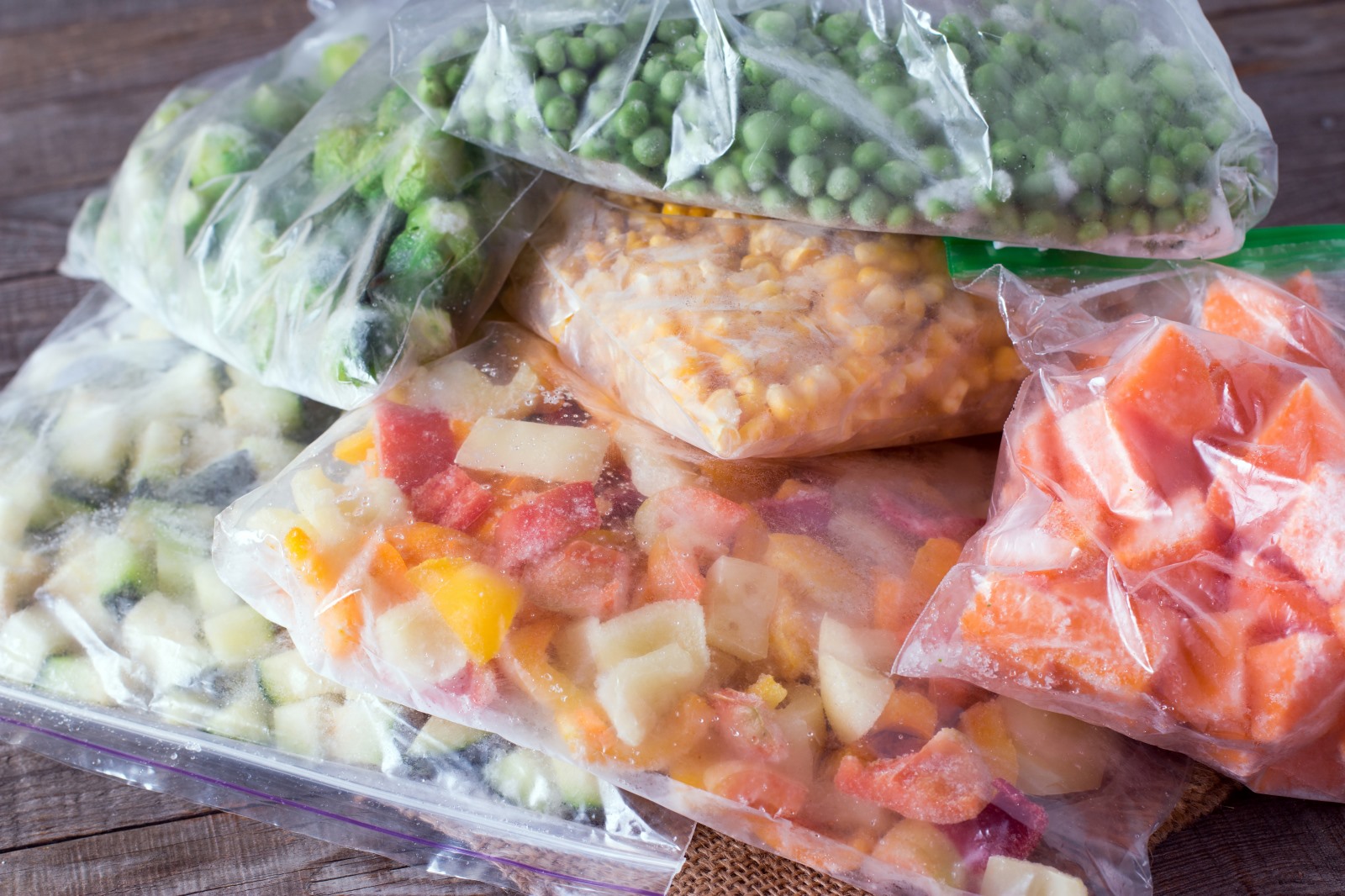 Fighting One of the World's Most Solvable Environmental Crises: Food Waste
If food waste were a country, it would be the third-largest emitter of greenhouse gases on the planet, representing the loss not just of food but of every unit of water, energy, land, and human labor that went into producing it.
Flexible packaging sits at the heart of the solution.
How flexible packaging prevents food waste:
- Superior Barrier Performance: Flexible films control oxygen transmission, moisture ingress, light exposure, and microbial contamination with a precision few other formats can match, directly extending the shelf life of perishable products.
Examples in practice:
-
- Modified atmosphere packs on fresh meat
- High-barrier pouches for coffee
- Vacuum-sealed films for cheese
Each represents not just a packaging decision, but a food preservation decision.
- In-Home Food Waste Reduction: Flexible films can be tailored to size, reuse, and visual needs to help consumers plan for and mitigate food loss at home. Emerging technologies are even helping notify consumers when food might have spoiled
-
- Resealable closures extend usability after opening
- Portion-controlled pack sizes reduce over-purchasing
- Transparent films allow consumers to assess product condition without opening it
- Intelligent packaging films and labels that change colors or indicate to the consumer when food has spoiled.
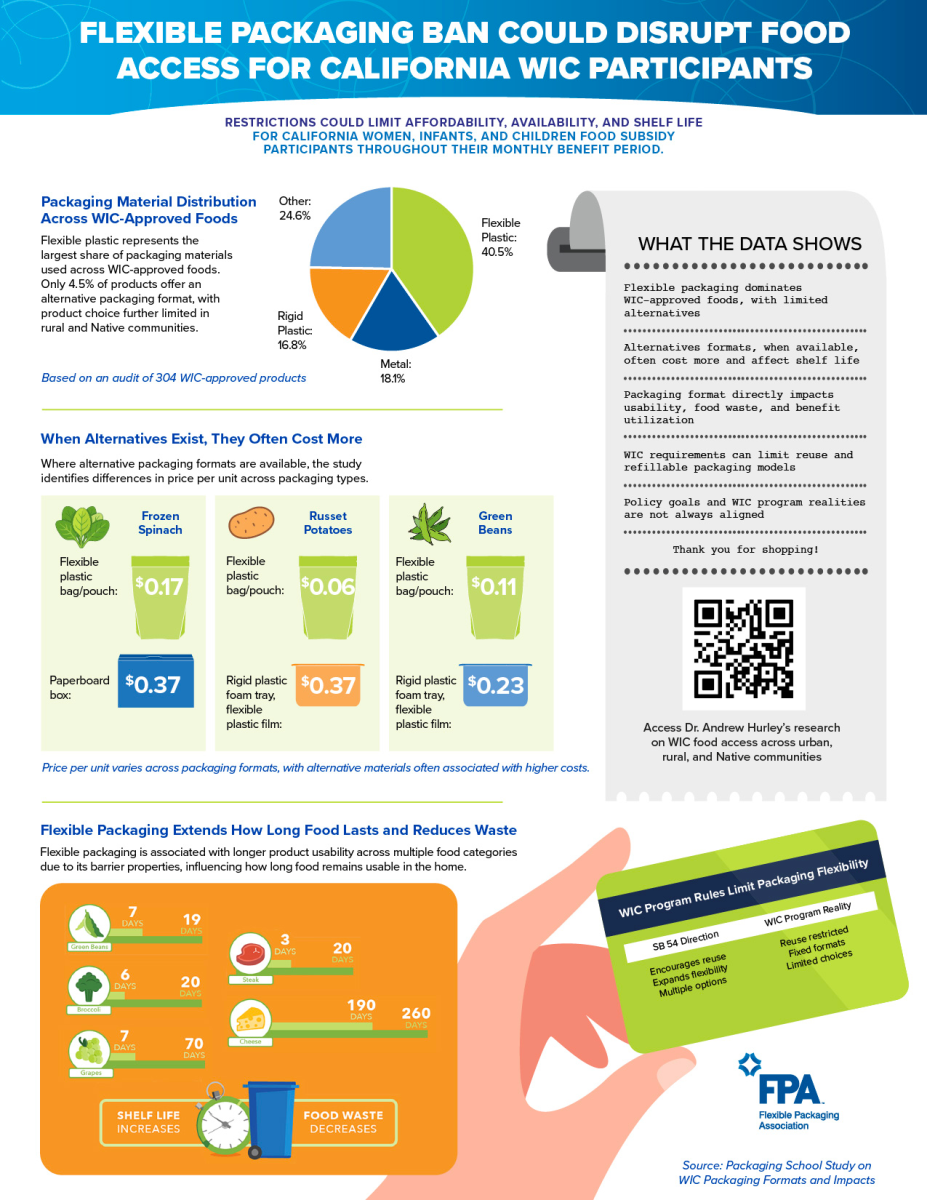
- Affordability & Access: Smaller, affordable portion sizes reduce the risk of buying more than can be consumed — benefiting lower-income consumers and reducing household food waste simultaneously.
- Emerging Markets: In regions with limited cold chain infrastructure, flexible packaging with strong passive barrier properties extends the reach of safe, preserved food into communities that may lack necessary cold chain infrastructure.
Protecting the food inside the pack is, in many cases, the single most effective sustainability function of flexible packaging.
|
Resource Name |
Resource Type |
|
Report |
|
|
Website |
Flexible Packaging & Climate Emissions
A Carbon Success Story When You Look at the Whole System
When greenhouse gas emissions from packaging are discussed, the conversation typically focuses narrowly on the material itself. For flexible packaging, this misses the majority of the story.
Where the carbon benefits compound:
|
Stage |
Flexible Packaging Advantage |
|
Material production |
Uses significantly less material — a flexible pouch can require up to 60% less plastic than an equivalent rigid container |
|
Logistics (outbound) |
Lighter and more compact formats allow more product per vehicle load, reducing journeys and fuel consumption |
|
Logistics (inbound) |
Ships flat at high density before filling, reducing pre-fill packaging logistics emissions |
|
Cold chain |
Barrier and insulating properties help maintain product condition with less refrigeration energy |
|
Food waste avoided |
Emissions avoided by protecting food that would otherwise be lost almost always significantly outweigh the production footprint of the flexible packaging itself |
Evaluated across its full life cycle, flexible packaging is generally a carbon success story.
Flexible Packaging & Accessibility
Designed Around Human Need
Accessibility is one of flexible packaging's most significant and least celebrated contributions. Its benefits reach consumers across every walk of life.
- For Lower-Income Consumers
- Lower material costs translate into reduced packaging costs, helping keep product prices accessible
- Smaller pack sizes and single-serve portions mean consumers are not forced to purchase more than they need or can afford
- Reduces both financial strain and household food waste simultaneously
- Lower material costs translate into reduced packaging costs, helping keep product prices accessible
- For Emerging & Developing Markets
Flexible packaging extends the reach of safe, preserved food and essential goods into regions where:
-
- Refrigeration infrastructure is limited or unreliable
- Supply chains are long
- Refrigeration infrastructure is limited or unreliable
- For Older Adults & People With Disabilities
For consumers living with arthritis, reduced grip strength, or limited dexterity, flexible packaging offers meaningful practical advantages:
-
- Flexible pouches and soft-sided packs require significantly less force to open and handle
- Resealable zippers allow repeated, easy access
- Tear notches reduce the effort and frustration of opening
- Reduces pain, frustration, and loss of independence for millions of people every day
- Flexible pouches and soft-sided packs require significantly less force to open and handle
- For Everyday Consumers
The lightweight nature of flexible packaging is an everyday practical benefit that is easy to take for granted:
-
- Reduces the physical burden of carrying goods
- Allows more product to be transported in a single trip
- Reduces the physical burden of carrying goods
Flexible packaging, at its best, is not just an industrial material solution; it is a format designed around human need, delivering dignity, affordability, and ease of use to consumers across every walk of life.